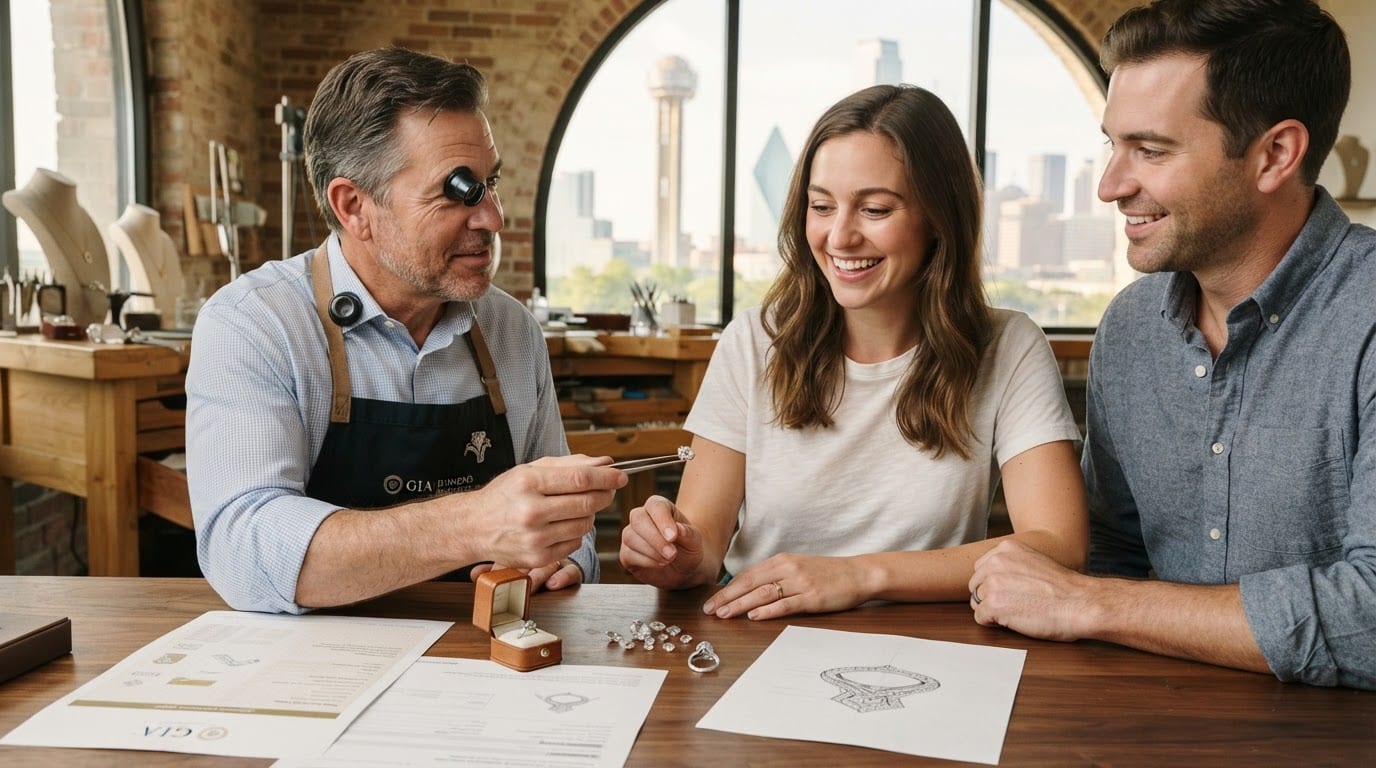
The first engagement ring decision is rarely about the diamond. It usually starts with a question about who the ring is for, what it should say, and how much flexibility the buyer has on timing. Those answers shape almost every choice that follows, from whether to start with a finished piece or a blank sketch to whether a grandmother’s stone should be reused.
Buyers searching for engagement rings in Dallas face a wide range of options, from showroom inventory to fully custom studios, and the differences in process, pricing, and documentation are larger than most marketing pages suggest. Understanding how those pieces fit together makes it easier to compare jewelers on substance rather than presentation.
Before visiting any shop, including Shapiro Diamonds, it helps to set three parameters: a realistic total budget with a margin for setting and taxes, a proposal date with buffer time, and a short list of design priorities such as metal color, setting height, and whether the stone needs to be a specific size. Consultations go faster and produce more useful quotes when the buyer can state those numbers clearly.
Made-to-Order or Ready-Made: Deciding How Your Ring Gets Created
Engagement rings reach the buyer through three main routes, and each has different costs and timelines.
- Showroom stock: The ring is already assembled, and the buyer chooses from existing settings and stones. Lead time is often same-day or within a few days for sizing. Price is the most transparent, but design flexibility is limited.
- Semi-custom settings: The buyer picks a catalog mounting, often a six-prong solitaire or a pavé band, then swaps the center stone, metal, or accent details. Typical lead times run two to four weeks, with one or two revision rounds included.
- Fully bespoke work: A designer produces a CAD model, often rendered in 3-D, and then casts and sets the piece. Lead times commonly run six to ten weeks, and each design revision adds time. Bespoke pricing reflects labor for drafting, wax modeling, casting, and hand finishing.
Custom work makes the most sense when the buyer has a specific stone that does not fit standard mountings, a design that combines an heirloom element with new metal, or a timeline long enough to absorb revisions. It makes less sense when the proposal is weeks away or when the buyer’s priorities are primarily the stone itself.
Price changes come from four sources: metal weight and karat, labor hours for design and setting, the number of accent stones, and the number of revision rounds. Ask each shop to itemize these categories so that two quotes can be compared directly.
Turning a Family Stone into a New Ring
Reusing an inherited diamond or gold piece can lower cost and add meaning, but not every stone is a good candidate. Some pieces need repair before they can be reset, and others carry hidden damage that only becomes visible under magnification.
Checking Whether an Old Stone Is Worth Reusing
A jeweler will typically inspect the stone under 10x magnification and check for the following:
- Chips and abrasions on the girdle and facet junctions, which can weaken a stone during setting
- Cut quality, including symmetry, polish, and whether the proportions still produce strong light return
- Previous repairs or fracture filling, which may be stable but can change how the stone responds to heat and cleaning
- Metal condition, including thinning shanks, worn prongs, and whether the gold alloy can be reshaped or needs replacement
Buyers can perform a few checks before a consultation. Note whether the stone shows a visible chip when viewed face-up with a loupe, whether any facets look rounded or dull, and whether the setting wobbles when gently pressed. Photograph the piece under daylight, and bring any original paperwork, even if it describes a stone that has since been recut or reset.
Gold is usually easier to reshape than platinum because it is softer and more forgiving, but both metals can be reworked. Shanks that have worn thin, however, often need replacement rather than repair. A designer will tell you whether the existing band can carry a new head or should be retired and remade.
Sentimental pieces should not be rushed. Ask for a written assessment before committing to a setting, and request a short hold period so the stone can be evaluated without pressure.
Matching a New Setting to an Existing Stone
Proportions determine how a reused stone looks in a new mounting. A deep stone set in a low, flat head can look sunken, while a shallow stone in a tall basket may appear to float. Head height, the metal visible around the girdle, and the number of prongs all change how much of the stone’s crown is exposed.
Prong style matters too. Four-prong settings expose more of the stone’s sides and can make a round brilliant look larger, while six-prong settings offer greater security for heavier stones. Bezel settings wrap the girdle entirely, which protects older stones with thin edges but reduces the visible surface.
When communicating preferences to a designer, describe the outcome rather than only the hardware. Phrases such as "I want the stone to sit close to the finger" or "I want more light coming through the bottom" give a designer something to act on. Bringing a photograph of a ring you like, along with the stone’s measurements, helps the designer model options accurately.
Where the Budget Actually Goes
The 4Cs describe the stone, but they do not show how the total price is divided. In a typical natural-diamond engagement ring, the center stone often accounts for the largest share of the cost, sometimes 60 to 75 percent of the wholesale value. The metal, setting labor, and design work make up the remainder, and the balance shifts depending on whether the ring is cast in platinum or 14-karat gold and how many accent stones it carries.
A lower-carat stone in a well-proportioned setting can look more impressive than a heavier stone in a bulky mounting. A 1.0-carat center stone with a slim gallery and a carefully chosen head may appear larger than a 1.25-carat stone in a thick, closed setting. Ask the designer to show you the same stone in two mountings before deciding that carat weight alone should drive the budget.
Lab-grown diamonds are a practical lever for buyers who want a larger stone or a higher grade than their budget allows. Lab-grown stones are chemically and optically identical to mined diamonds, and they typically sell for a fraction of a comparable natural stone’s price. The tradeoff is resale value, which is generally lower for lab-grown stones, and some buyers prefer natural stones for sentimental reasons. Buyers should confirm that any lab-grown stone is accompanied by a report that identifies it as laboratory-grown.
Taxes also belong in the budget. Texas charges a 6.25 percent state sales tax, and the combined rate in Dallas is 8.25 percent, so a $5,000 ring carries roughly $412 in tax. Confirm whether a quoted price includes tax before comparing offers.
Certificates, Appraisals, and Protecting the Purchase
A grading report is a laboratory description of a stone at the time it was examined. Reports from the Gemological Institute of America (GIA) or International Gemological Institute (IGI) document carat weight, color, clarity, cut grade for round brilliants, and fluorescence. They do not certify value, guarantee that the stone will hold its price, or confirm that the setting is secure. A report also does not assess the metal, the craftsmanship, or the condition of the mounting.
An independent appraisal is a separate document. It states the replacement value or fair market value of the piece as prepared by a qualified appraiser, often a member of the American Society of Appraisers, the International Society of Appraisers, or the Accredited Gemologists Association. Appraisers typically follow the Uniform Standards of Professional Appraisal Practice (USPAP) and charge a flat fee. A retailer’s price tag reflects what the shop charges, which can differ from what the piece would cost to replace or what it would sell for.
Buyers should keep the following on file:
- The original grading report, with the report number and a copy of the stone’s laser inscription if one exists
- An itemized receipt showing the stone, metal, labor, and tax
- A current appraisal dated within the past two to three years, updated as market values change
- Photographs of the ring from several angles, including the setting and any engraving
- Documentation of any repairs, resets, or stone replacements
Homeowners and renters insurance policies often cap jewelry coverage at a low figure. Most buyers add the ring to a scheduled personal property endorsement, which requires the appraisal and receipt. Contact the insurer before the proposal to confirm what documentation it requires.
Timing the Purchase Around the Proposal
Working backward from the proposal date is the most reliable way to avoid rush fees and compromised choices. A realistic schedule usually includes an initial consultation four to six weeks before the proposal, a design approval window of one to two weeks, a production period that depends on whether the ring is semi-custom or bespoke, and a final buffer of several days for inspection and sizing.
Sizing requires attention early. Many shops can size a ring within a half size without visible change, but larger adjustments, especially on pavé or eternity-style bands, may require more work or may not be possible. If you know the recipient’s ring size, provide it at the consultation. If not, ask whether the shop offers a sizing guide or a temporary ring that can be used to estimate the fit.
Resizing after delivery is common. Gold bands can typically be adjusted by up to one full size in a single pass, while platinum usually requires a sizing stock insert and more labor. Ask whether the first resize is included in the purchase price, and confirm whether the adjustment affects the stone’s setting or the engraving.
Finally, schedule the first consultation early enough to leave room for a second visit. A single meeting rarely settles stone selection, mounting style, and budget at the same time. Two conversations separated by a few days usually produce better decisions than one long session, and they give the buyer time to confirm the choices against the documents and appraisal they will keep for years.
