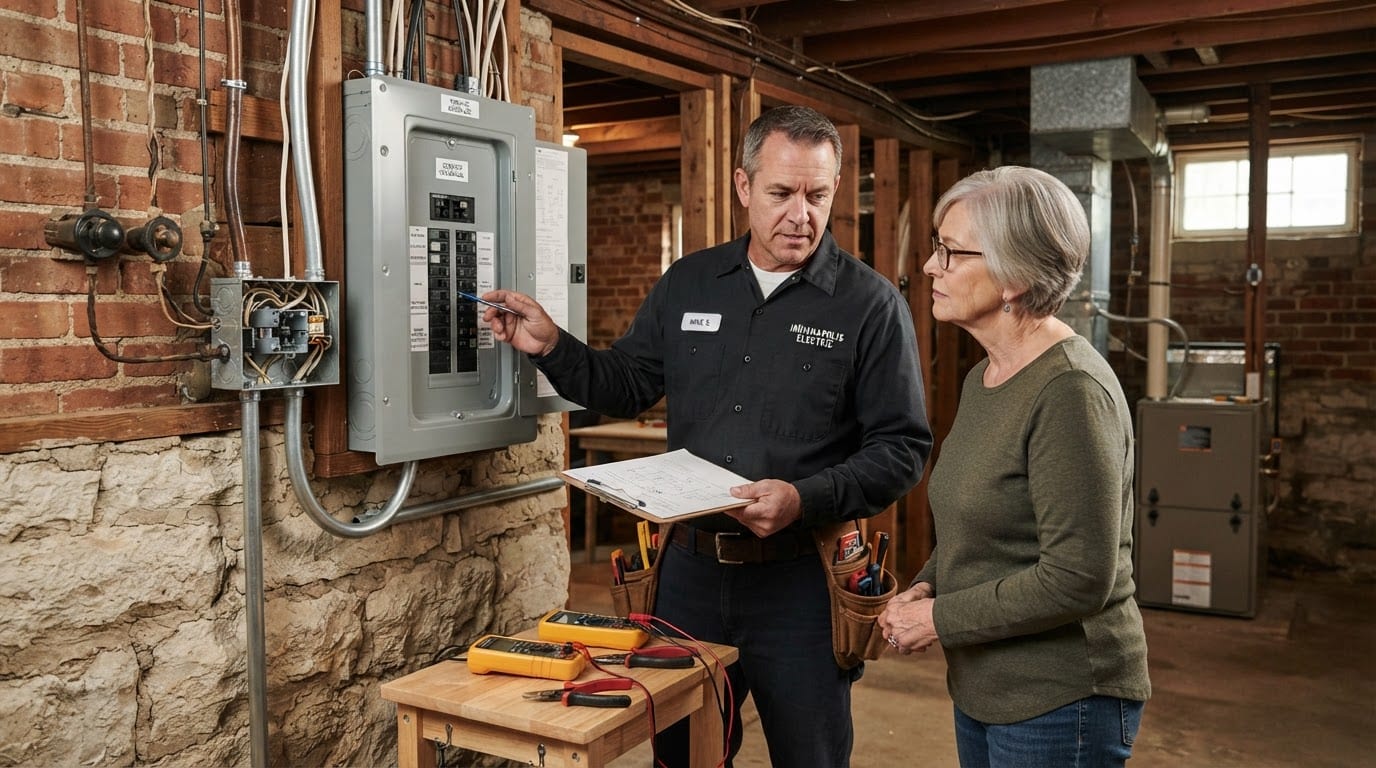
A flickering bedroom light or a breaker that trips every time the air conditioner starts can seem like a small nuisance. In many Indianapolis homes built before 1980, though, those symptoms often point to an electrical system that was designed for a very different set of appliances. Recognizing the warning signs early, and understanding how panel capacity, circuit planning, and surge protection fit together, can prevent overheating, nuisance outages, and damaged equipment.
Homeowners searching for a Residential electrician Indianapolis are usually facing one of a few decisions: repairing an existing problem, upgrading service to support new equipment, or preparing for a major addition such as an electric vehicle charger. Each decision depends on the same foundation, which is an accurate picture of what the home’s electrical service can safely deliver.
Planning starts with the service entrance and main panel, then moves outward to individual circuits. Any work that changes service capacity should be preceded by a written load evaluation and handled under an electrical permit. Homeowners working with zimmermanelectricindy or any other contractor benefit from asking early how the project will be documented, which inspections will be required, and what the finished system should look like on paper. Those answers matter as much as the work itself when the home is later sold or an insurance claim is filed.
Reading the Warning Signs in Older Indianapolis Homes
Flickering lights, warm outlets, and frequently tripping breakers are not normal, and they usually indicate one of three conditions: an undersized service, an overloaded circuit, or a loose or deteriorated connection. Loose terminations are a particular concern because resistance at a connection generates heat. A cover plate or outlet that feels warm, smells of scorching, or shows discoloration should be treated as urgent.
Many homes built before 1980 were wired with 60-amp or 100-amp services. A 60-amp service delivers roughly 14 kilowatts at 240 volts under ideal conditions, while a 100-amp service delivers about 24 kilowatts. Those figures sounded adequate decades ago, but a central air conditioner, electric range, clothes dryer, dishwasher, and water heater can together draw far more than that during peak use, especially when they run at the same time. Older homes may also rely on two-wire circuits, aluminum branch wiring, or fuse boxes that have been partially converted, all of which can complicate capacity planning.
A safety inspection is worth scheduling in several situations:
- The home is more than 40 years old and has never had a documented electrical evaluation.
- Breakers trip repeatedly, or a fuse box shows signs of overheating or improvised repairs.
- Outlets are ungrounded, lack GFCI or AFCI protection where required, or show burn marks.
- A recent renovation added significant load without a corresponding service review.
Some contractors recommend inspections every three to five years for homes over 40 years old. That interval is a practical guideline rather than a universal code requirement, but it provides a useful planning rhythm, particularly in neighborhoods such as Broad Ripple and Meridian-Kessler, where many houses from the early and mid-twentieth century still carry their original service or early modifications.
Deciding Whether Your Panel Needs a 200-Amp Upgrade
A load assessment is the starting point for any capacity decision. An electrician calculates the home’s expected demand using the methods in NEC Article 220, which assign standardized demand factors to general lighting, small appliance circuits, heating and cooling, and fixed appliances. The result shows whether the existing service has enough margin to add new equipment safely. Without that calculation, adding a heat pump, an induction range, or a hot tub circuit is guesswork, and the panel may be overloaded without any visible symptom until something fails.
Common signs that a panel is at or near capacity include:
- Breakers that trip only when two or more large appliances run together.
- A panel with no open slots, or one that requires tandem breakers in spaces not rated for them.
- Dimming lights when the dryer or HVAC system starts.
- A meter base or service entrance conductor that is discolored, hot, or visibly undersized.
A subpanel can distribute power to a garage, workshop, or addition, but it does not increase the total capacity of the home. Every amp a subpanel feeds still comes through the main service. A subpanel is useful when the main panel has no room for new circuits but the existing service has spare capacity. When the service itself is the limit, the only real solution is increasing the service rating.
What Affects Panel Upgrade Costs
Upgrade pricing varies widely because each home presents different conditions. The main cost drivers include:
- Amperage: Moving from 100 amps to 200 amps requires larger service conductors, a new main breaker, and a panel with more spaces and higher interrupting capacity.
- Service complexity: Overhead service drops, underground feeds, and long runs from the meter to the panel add labor and materials.
- Meter work: Utility coordination may be required to replace the meter base or adjust the service connection. Scheduling depends on the utility, which adds time even when the electrical work is straightforward.
- Wiring modernization: Knob-and-tube remnants, aluminum branch circuits, or ungrounded circuits may need to be corrected before the new panel can be energized, which can expand scope significantly.
For planning purposes, a panel replacement in Indianapolis is often estimated in the range of $2,500 to $3,000, depending on amperage and complexity. A full 200-amp service upgrade with meter and service entrance work, or a home requiring extensive rewiring, can cost considerably more. These figures are estimates only and vary with materials, site conditions, access, local market conditions, and the specific scope of work. A written estimate should break down labor, materials, permits, and any utility fees so that the figures can be compared accurately.
Permits and Inspections Through Indianapolis DBNS
Electrical service changes in Indianapolis are permitted through the Department of Business and Neighborhood Services (DBNS). The usual sequence involves submitting plans or a scope description, paying the permit fee, completing rough-in work, scheduling an inspection before walls are closed, completing the finished installation, and passing a final inspection before the system is approved for use.
Permits can feel like an added expense, but they serve a practical purpose. A documented, inspected upgrade provides evidence during a home sale that the service was modified under code. Insurers may also ask for permit records when investigating an electrical fire or damage claim. Permit fees are typically a small share of the total project budget, yet they should be included in the initial estimate so that homeowners are not surprised by additional charges later.
Planning Circuits for EV Chargers and Heavy Appliances
A Level 2 electric vehicle charger operates on 240 volts and typically requires a dedicated branch circuit. Most residential units are rated at 32 amps or 40 amps of continuous output. Under NEC Article 625, EV supply equipment is treated as a continuous load, which means the branch circuit and overcurrent device must be sized at 125 percent of the charger’s rated current. A 32-amp charger therefore generally calls for a 40-amp breaker and appropriately sized conductors, while a 40-amp charger generally calls for a 50-amp circuit. Because of this, a formal load calculation is essential before installation. The calculation confirms whether the service can carry the charger along with existing loads.
The choice between a full service upgrade and a subpanel depends on available capacity:
- Subpanel: Appropriate when the main service has enough reserve capacity but the main panel lacks space or breaker positions. It is often a practical choice for a garage installation.
- Full service upgrade: Appropriate when the calculated load exceeds the existing service rating, or when multiple future loads, such as a heat pump, an electric range, and a hot tub, are planned together.
Permits are required for Level 2 installations under Indianapolis rules. Requiring a permit ensures that the circuit, disconnect, grounding, and overcurrent protection are inspected against NEC Article 625 and related provisions. This matters because EV chargers operate for long periods at high current, so undersized conductors or poor terminations can overheat more readily than a typical appliance circuit.
Other high-draw loads belong in the same capacity discussion. Hot tubs typically require a dedicated 240-volt GFCI-protected circuit under NEC Article 680, and their demand can be substantial. Electric ranges and cooktops often draw 40 to 50 amps or more on a dedicated circuit. A responsible plan evaluates all of these loads together rather than adding them one at a time, because each addition can reduce the margin left for the next.
Protecting Electronics and Appliances From Power Surges
Voltage spikes reach household electronics in several ways. Lightning strikes and utility switching can send transient surges through overhead lines. Outage restoration can create sudden voltage changes. Large motors, such as compressors in refrigerators, air conditioners, and well pumps, produce switching transients when they start and stop. Over time, these events degrade power supplies, control boards, and sensitive electronics, even when the damage is not immediately visible.
Whole-home surge protection devices (SPDs) are installed at or near the main service panel. They divert transient energy before it travels through branch circuits. Under recent editions of the NEC, service-level SPDs are required for many new dwelling-unit installations and replacements, and they are typically rated to UL 1449 standards. A whole-home device provides a first line of defense for the entire electrical system, but it does not replace point-of-use protectors. Plug-in or power-strip surge protectors with appropriate joule ratings still play a role in protecting individual devices such as computers, networking equipment, and home theater components, particularly because the protective response varies with the device and the surge.
Surge protection has limits. It cannot compensate for a loose connection, an undersized service, or a failed grounding electrode system. If equipment fails repeatedly, if an SPD indicator shows a fault, or if a home has signs of wiring damage after a storm, a broader electrical inspection is the better next step. Surge protection reduces risk, but it does not correct the underlying conditions that create hazards.
Choosing a Licensed Electrician and Reading Your Estimate
Homeowners should verify three things before hiring an electrical contractor. First, confirm the state license through the Indiana Professional Licensing Agency. Second, request a certificate of liability insurance and, where applicable, workers’ compensation coverage, so that the homeowner is not exposed to liability for injuries on site. Third, ask about experience with DBNS permitting and the inspection process, since a contractor familiar with local requirements can avoid delays.
A detailed written estimate should describe the scope of work in specific terms, including the service amperage, panel model, breaker types, conductor sizes, and any utility coordination. It should list permit fees and who is responsible for pulling the permit, identify the materials to be used, state the expected timeline, and clearly separate estimated figures from fixed prices. Questions to ask before the first visit include:
- Will you perform a load calculation before recommending a service size?
- Which permits are required, and who will schedule inspections?
- What happens if the inspection reveals additional wiring problems?
- How long will the home be without power, and will the utility need to be scheduled?
- Who is the crew lead, and how will progress be communicated?
Response times vary with season and workload, so it is reasonable to ask about typical scheduling windows for estimates and for urgent repairs. Contractors who explain the process and provide written documentation are generally easier to work with throughout the project.
On inspection day, the electrician should be present or accessible, the permit should be posted or available, and the inspector will check the work against the approved scope. Items commonly reviewed include conductor sizing, grounding and bonding, labeling of the panel directory, and proper terminations. Once the work passes final review, request a copy of the approved permit and final inspection record. Keep those documents with the home’s records, along with the load calculation and the equipment specifications, so that future buyers, insurers, and electricians can verify what was installed.
