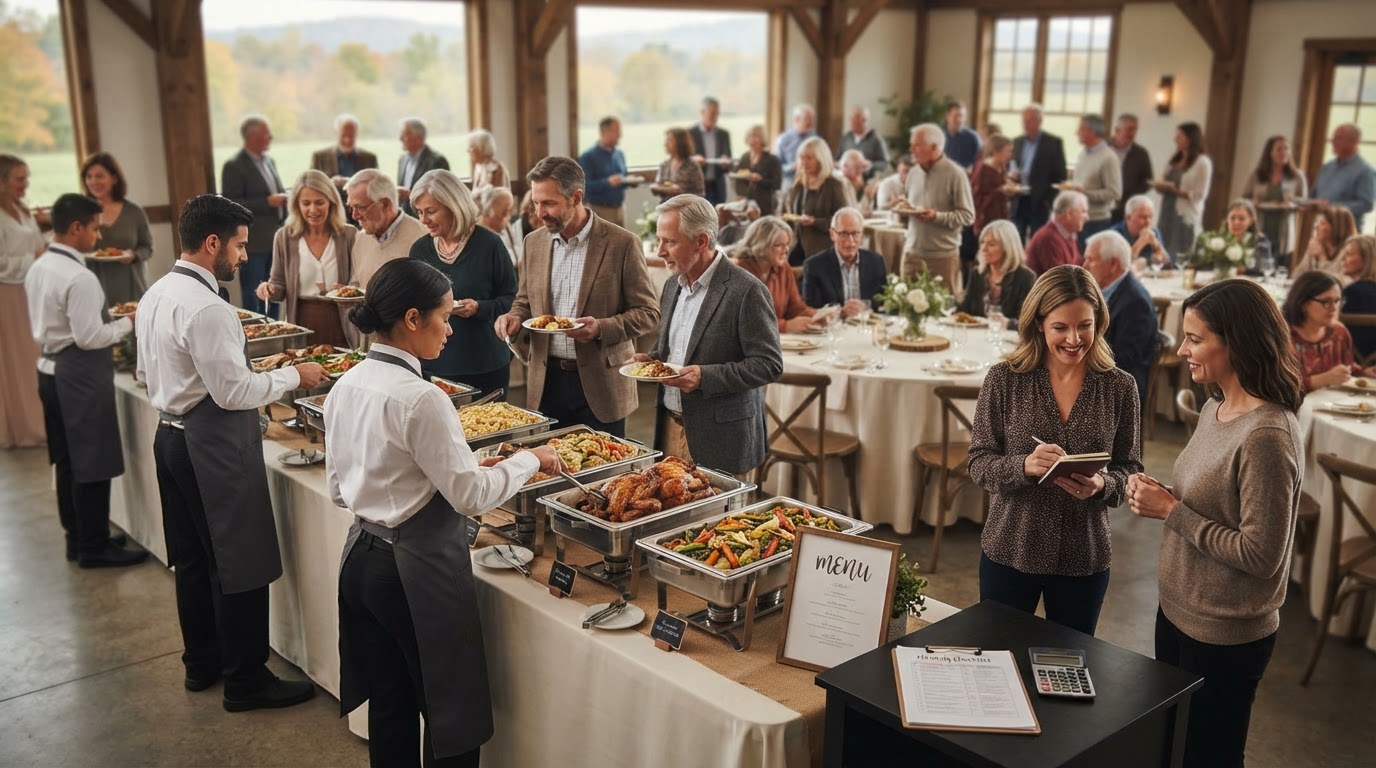
A 40-person lunch looks simple until the first quote arrives with a per-person price, a delivery fee, a staffing line, and a tax figure that doesn’t match the number on the menu. Many hosts discover these gaps only after they have committed to a date. Planning food for a group is less about finding the lowest number and more about understanding what that number includes.
Buyers who search for catering west chester pa typically compare several kinds of operators: Italian specialty markets, casual pizzerias, restaurants with catering menus, and full-service event caterers. Each has different minimums, service models, and pricing structures. A quote that looks cheaper on paper can cost more once delivery, equipment, and labor are added, so comparing providers on equal terms is the first skill a host needs.
Format matters as much as price. A salad-and-pizza operation such as The Tomato Shack salad & pizza co, West Chester is built around different holding, portioning, and transport requirements than a plated dinner service. Asking each provider how it handles those differences will reveal more about the real cost of your event than any single menu line.
Setting a Realistic Budget Before You Request Quotes
A catering total is the sum of several components, not just food. Start with headcount, then apply the per-person rate for your chosen menu tier. Add the service style cost, delivery, staffing, equipment, linens, and applicable Pennsylvania sales tax. Some providers quote food as an all-inclusive per-person figure; others itemize everything. Either approach works, but the totals must be comparable.
The following worked examples use hypothetical rates to show how the math scales. They are not local price benchmarks; substitute actual quotes when you have them.
Assumptions: $16 per person for a buffet, $75 delivery, $30 per staff hour for four hours, one attendant per 25 guests, $2 per guest for linens, and 6% tax applied to the subtotal for illustration.
40 guests – Food: 40 × $16 = $640 – Delivery: $75 – Staffing: 1 attendant × 4 hours × $30 = $120 – Linens: 40 × $2 = $80 – Subtotal: $915 – Tax (6%): $54.90 – Total: $969.90, or about $24.25 per guest
50 guests – Food: 50 × $16 = $800 – Delivery: $75 – Staffing: 2 attendants × 4 hours × $30 = $240 – Linens: 50 × $2 = $100 – Subtotal: $1,215 – Tax (6%): $72.90 – Total: $1,287.90, or about $25.76 per guest
Ten additional guests raised the total by roughly $318, far more than the $160 of added food. The difference comes from the second attendant, which staffing ratios often require once a group crosses a threshold. Menu tiers create similar jumps. Moving from $16 to $19 per person for 50 guests adds $150 in food alone, and the tax and any upgraded equipment push the increase higher.
Line Items Worth Asking About in Writing
Ask every provider to confirm the following in writing before comparing totals:
- Delivery and travel fees, including whether the zone is capped and how distance is measured
- Service or staffing fees, including the attendant ratio and minimum hours
- Gratuity, which may be automatic for larger groups and is not always optional
- Serving equipment, such as chafing dishes, sternos or induction units, serving utensils, and insulated carriers
- Linens and disposables, including plates, cutlery, napkins, and table covers
- Minimum order requirements, which may apply to delivery-only orders
- Tax treatment, since the taxability of prepared food and catering can depend on how the order is structured
A low per-person price can rise quickly once these items are added. A $14 quote that excludes staffing, equipment, and delivery may end up costing more than a $17 quote that includes them.
Choosing Budget-Friendly Menus Without Shortchanging Guests
There is no single "cheapest food to cater." Cost depends on three drivers: ingredient cost, labor, and perishability. Ingredient cost is the obvious one, but a dish with inexpensive ingredients that requires extensive hand preparation can cost more than a pricier item that arrives ready to portion. Perishability matters because items that must be held at safe temperatures, such as cooked proteins and dairy-based salads, require refrigeration, hot holding equipment, and tighter timing.
Pasta, grain salads, potato salads, sandwich platters, and roasted vegetables are common budget anchors, and each has trade-offs:
- Pasta stretches well and holds reasonably, but it absorbs sauce and can dry out in chafing dishes. Plan roughly 4 to 6 ounces cooked per guest when it is a side, more if it is the main.
- Grain and potato salads are inexpensive and can be made in advance, but they are often perceived as filler when served alone. Dressing them well matters more than the base ingredient.
- Sandwich platters are efficient for lunch but thin out quickly for hungry crowds. Two halves per guest is a common baseline for a light meal; three or more may be needed for a full lunch.
- Roasted vegetables are affordable and well suited to warm holding, but they rarely satisfy appetite on their own.
Balancing a Premium Centerpiece with Lower-Cost Sides
A single high-value item, such as a carved protein or a signature pizza, anchors the spread visually. Pair it with inexpensive sides that have color, texture, and contrast. Two substantial sides and one lighter salad generally feel more generous than four small sides, and they reduce waste because guests tend to take a portion of each.
Dietary Needs and Their Effect on Cost
Vegetarian options typically cost less than meat-based entrées, but a separate vegetarian line with its own serving utensils and labeling adds prep steps. Gluten-free requests require separate prep surfaces, dedicated utensils, and sometimes separate cooking water to avoid cross-contact. Allergy considerations such as tree nuts, shellfish, or sesame can require ingredient review and written labeling. Ask providers whether these modifications are priced as separate items, and request an ingredient list for any dish a guest may need to avoid.
Matching Service Style to Your Venue and Timeline
Service style shapes both cost and guest experience:
- Drop-off is the least expensive and requires the least setup. Guests serve themselves from containers the host or staff places on tables. It works well for informal lunches but offers little control over presentation.
- Staffed buffet adds attendants who replenish trays and manage the line. It costs more but keeps food at proper temperature and reduces wait times for larger groups.
- Family-style places shared platters on each table. It feels generous and social, but it requires more tables, more serving pieces, and careful portioning.
- Plated service is the most expensive and labor-intensive. It suits formal dinners and requires kitchen staff, servers, and a longer timeline.
Venue Questions That Affect Planning
Before booking, confirm the following details with the venue and provider:
- Kitchen access, including whether there is a sink, refrigeration, and a space for reheating or finishing food
- Loading and parking, especially for multi-tray deliveries and any stairs or elevator access
- Indoor versus outdoor setup, which affects holding temperatures, shade, and pest management
- Serving equipment, which may or may not be included in the quote
Outdoor events in southeastern Pennsylvania face warm, humid summer conditions. Hot food should be held at 135°F or above and cold food at 41°F or below, consistent with the FDA Food Code, and outdoor tables should have shade and ice-based cold holding where needed. Food that stays in the temperature danger zone for more than two hours should be discarded.
Timing by Meal Period
Breakfast events generally use smaller portions per guest, with pastries and fruit requiring fewer hot holding units. Lunch events often run longer and need more protein and sides to satisfy appetite. Evening receptions usually combine appetizers with a main course, so quantities shift toward smaller bites and multiple stations. Each change affects holding time and the number of staff needed to keep food at safe temperatures throughout service.
Ordering for 50 Guests: Headcounts, Lead Times, and Quantities
A typical timeline runs as follows:
- Menu selection: Confirm the menu and service style, usually four to six weeks before the event for a group of 50.
- Headcount confirmation: Provide a preliminary count early, then a firm count closer to the event.
- Deposit: Most providers require a deposit to hold the date, often a percentage of the estimated total.
- Final guest count deadline: Typically several days before the event. Confirm this date in writing.
- Day-of coordination: Confirm delivery time, setup location, staff arrival, and a contact number for the event day.
Estimating Quantities
For a meal with an entrée, two sides, and dessert, a practical starting point for 50 guests is:
- Entrée: 6 to 8 ounces cooked protein per guest, or about 300 to 400 ounces total, depending on bone-in weight and cooking loss
- Sides: 4 to 6 ounces each, with two or three sides for a full meal
- Appetizers: 3 to 5 pieces per guest for a cocktail hour before dinner, more if it replaces a meal
- Dessert: One portion per guest, or a smaller portion with a shared option
Adjust these figures for the audience. Groups with many teenagers or active workers often eat more, while a mixed-age reception may eat less overall.
Building in a Buffer
Add roughly 5 to 10 percent to the confirmed count for last-minute RSVPs, staff, and any guests who arrive unannounced. Ask providers how they handle changes after the final count deadline. Some charge for every additional guest at the per-person rate, others add a surcharge for last-minute increases, and some may not be able to add guests at all. Knowing this policy before you confirm the headcount prevents surprises.
Common Ordering Mistakes to Avoid
- Waiting too long to book during busy seasons, such as spring graduations and the December holiday period, when popular providers may fill their schedules.
- Confirming a headcount without asking about the guest-count change policy. A count that drops after the deadline may still be billed in full.
- Overlooking pickup or delivery windows and responsibilities. Confirm who handles setup, serving, breakdown, and cleanup, and whether equipment must be returned clean.
Questions to Ask Before Booking and Warning Signs to Watch For
Before signing, ask each provider:
- What insurance is carried, and will the provider supply a certificate of insurance on request?
- Do staff hold food-handling credentials, such as ServSafe Food Handler or ServSafe Manager certification?
- Is the food prepared in a licensed facility, and what inspection record does it hold with the appropriate authority? In Chester County, restaurant and food facility inspections are handled by the county health department and the Pennsylvania Department of Agriculture depending on the facility type.
- What exactly is included in the quote, and what is billed separately?
- What are the cancellation terms, and when does the deposit become nonrefundable?
- Is there a leftover policy, and are containers or safe reheating instructions provided?
- What are the staffing ratios, and who manages service?
- What is the backup plan if delivery is delayed or equipment fails?
Warning Signs
Several signals suggest a quote needs more scrutiny:
- Vague pricing that describes the per-person rate without listing extras
- No written contract or a contract that does not specify menu, timing, and cancellation terms
- Unclear delivery zones or fees that are not stated until the day of the event
- No clear menu details, such as portion sizes, ingredients, or allergen information
A Decision Framework for Comparing Quotes
To compare providers on equal terms, build a single worksheet with the same headcount, menu, service style, and date for every quote. Record the base food price, delivery, staffing, equipment, linens, gratuity, tax, and deposit terms. Then note the cancellation policy, guest-count change policy, and backup plan. The lowest total is not always the best value. The strongest quote is usually the one whose written terms match your event’s needs with the fewest unknowns.
